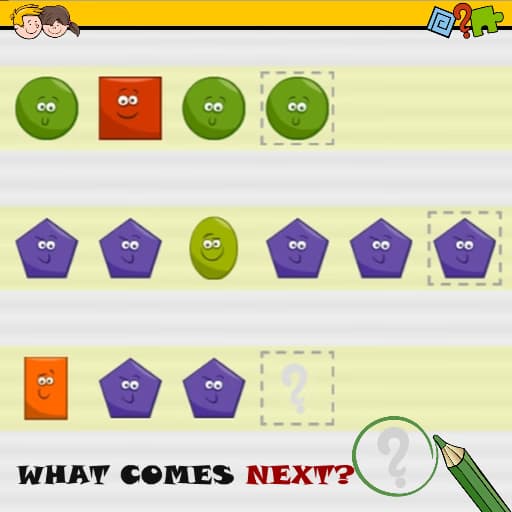
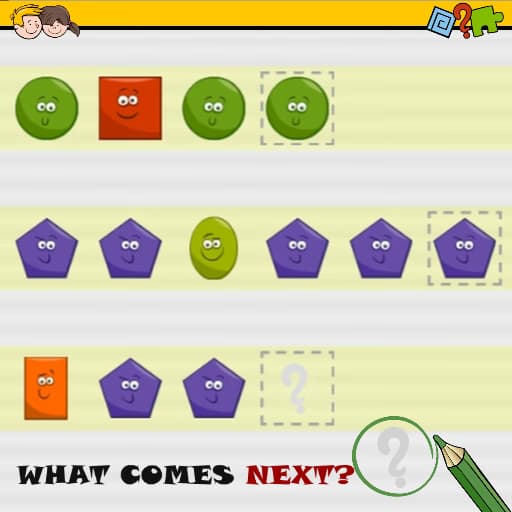
 What Comes Next
Each level presents a unique sequence or arrangement, such as shapes, numbers, or colors, and leaves a blank space for you to fill in. Your task is to study the existing pattern and decide what logically follows. This style keeps your mind sharp and is perfect for players who enjoy quick, cerebral challenges.
Some patterns may be simple alternations, while others require attention to detail or mathematical reasoning. The difficulty increases as you progress, introducing more complex sequences and less obvious answers. Try to spot repetitions, progressions, or rotations that hint at the rule behind the pattern.
What Comes Next typically allows unlimited attempts, so you can experiment with different answers. There's no timer pressure, encouraging thoughtful play and letting you learn from mistakes. If you get stuck, you can try new solutions until you find the correct match.
You can play What Comes Next for free in your browser, with no downloads or sign-ups required. It runs smoothly on school and work networks, letting you enjoy quick, skill-based puzzles anywhere.
The goal in What Comes Next is to identify the pattern in each puzzle and drag the correct item into the blank space to complete the sequence. Use the mouse or touch controls to select and drag the answer into position. Pay close attention to colors, shapes, numbers, or the order in which items appear. As you progress, patterns become trickier, requiring more analysis and logical thinking. Each correct answer advances you to the next level. Look for subtle cues—some puzzles may use rotation, grouping, or mathematical progressions that aren't obvious at first glance.
Spot the sequence - Always check for repeating or alternating elements in the pattern. Ignore distractions - Focus on the main features; background details usually aren’t relevant. Test your answer - Drag and drop different options if you’re unsure; there’s no penalty. Break it down - If stuck, split the pattern into smaller parts to find the rule. Look for position - Sometimes spacing or orientation is the key to solving the puzzle.