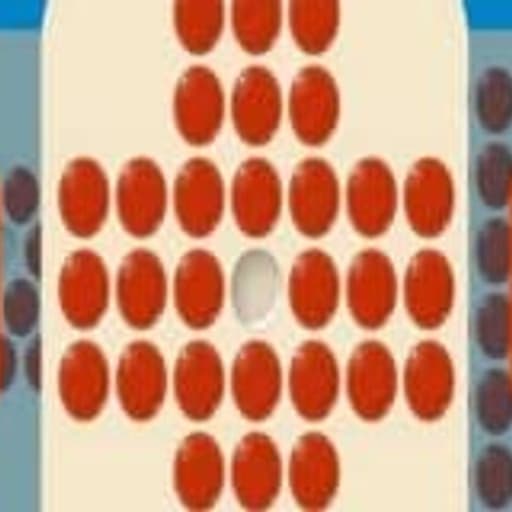

The board starts in a cross formation packed with pegs, except for one empty space. Each turn, you select a peg, then jump it over an adjacent peg into an open spot to remove the jumped peg.
The round continues until no more moves are possible or you achieve the optimal outcome of leaving a single peg. Every choice influences the rest of your game, making careful planning essential.
Peg Solitaire shines through its straightforward rules and deep strategic layers. While the premise is simple, finding the right sequence is challenging and requires patience.
The single-elimination board means every round is a new spatial puzzle, unlike the randomness found in other solitaire card or tile games. Success relies on positioning and the order of your jumps.
Some starting boards in Peg Solitaire can’t be solved, which adds to the replay value. Mastering the game means recognizing which layouts are winable and planning several moves ahead.
There are multiple board variations, so advanced players can test different strategies and solutions for a fresh challenge each time.
Peg Solitaire is available free in your browser—no downloads or logins needed. It’s unblocked and works on school or work networks for quick, accessible play anytime.
The goal in Peg Solitaire is to remove all pegs from the board except one by jumping pegs over each other. Each jump eliminates the peg that’s jumped over.
Use your mouse or tap to select a peg, then click or tap an empty spot two spaces away in a straight line to make a jump. Only adjacent pegs can be jumped.
Plan your moves carefully, as every jump affects which options remain. Play until you cannot make any more moves or achieve the ultimate goal of a single peg left on the board.
If you get stuck, you can reset the board and try a different sequence to find a solution or improve your performance.
Think ahead - Try to visualize several moves in advance to avoid trapping pegs. Center control - Focus on clearing the outer pegs early, aiming to finish in the center. Don’t rush - Each move counts, so take your time planning the best sequence.
Corner traps - Be cautious with corner pegs as they’re easy to isolate and hard to remove late. Restart often - If you hit a dead end, restart and experiment with new sequences.